
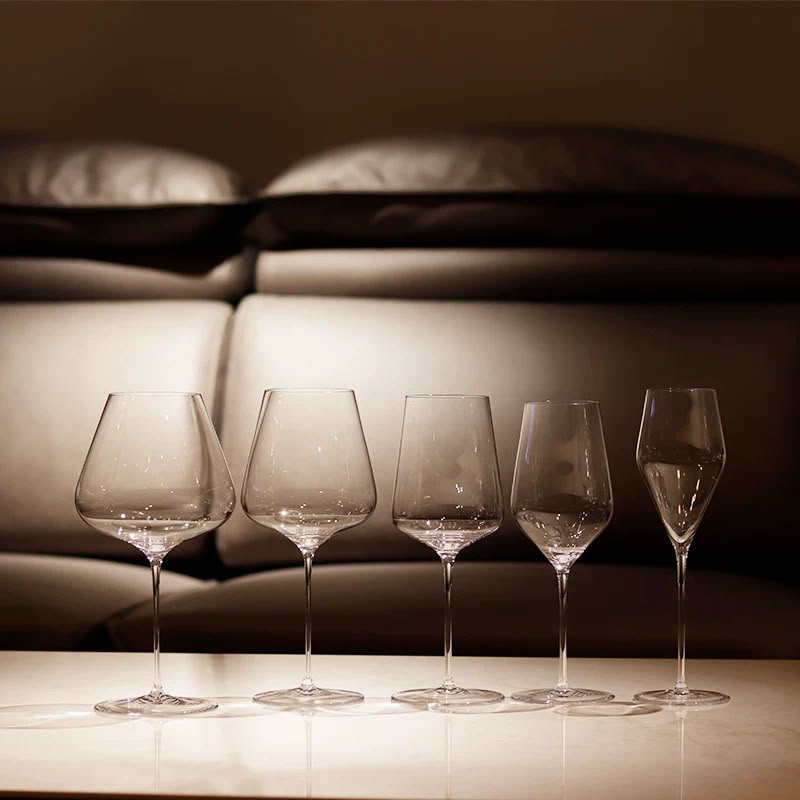
The honest answer is no
You can enjoy wine from one well-proportioned glass. The wine will not refuse to be delicious because the bowl was designed for another grape. What changes with a broader collection is the host’s ability to choose how a wine is presented—and the pleasure of noticing those differences over time.
I think of glassware the way I think of knives. One capable chef’s knife can handle most kitchen work. A boning knife or slicer becomes useful when the task is frequent enough to justify a more precise tool. Start with quality and fit. Add specialization when it brings real value to your routine.
The one-glass table
Choose a medium-to-generous bowl with a clear taper, a comfortable stem, and enough height to feel appropriate at dinner. It should welcome the red or white wines you pour most often and have a silhouette you are happy to set out for guests. A broad aromatic glass such as Pinot Luxe is a compelling all-rounder when you value aroma and generous proportions.
The advantage is calm: one storage footprint, one washing routine, and a coherent table. The compromise is temperature and scale. A large red-wine bowl can feel oversized for a small dessert pour, and a compact white-wine shape may not give a mature red much breathing room. For many homes, that tradeoff is entirely reasonable.
The two- or three-glass table
This is the system I recommend most often. Choose one red-wine shape and one white or sparkling shape. Add a second red shape if you regularly move between delicate aromatic reds and structured full-bodied wines. You gain useful contrast without making every dinner a stemware inventory exercise.
For example: Pinot Luxe for aromatic reds and fuller whites, Sauvignon Luxe for crisp whites, and Sparkling Luxe for Champagne and other traditional-method wines. Another household might choose Cabernet, Chardonnay, and Rosé. The categories matter less than choosing around what you actually serve.
The purpose-shaped table
A complete collection is valuable when wine is a serious interest, when you host frequently, or when the choice of glass is part of the experience you want to create. It lets you serve Syrah differently from Barolo, or compare Chardonnay in a broad white-wine bowl and Sauvignon Blanc in a tighter one. The collection becomes an instrument for attention.
It also creates a visually composed table. Ten silhouettes should not look like ten unrelated objects. The Luxe Series was conceived as a family, so differences in bowl geometry live within a consistent language of fine stems, ultra-light presence, and balanced bases.
Four questions before you buy
Ask what you pour, how many people you host, how much protected storage you have, and how you prefer to wash. Then consider whether you want one shape to disappear into the background or several shapes to help tell the story of a meal. Those answers are more useful than a universal list of required glasses.
The Find Your Glass guide begins with those practical decisions. Use it to choose a first shape, then live with that glass for a few bottles. A collection built from observation will feel personal. A collection built from obligation usually remains in the cabinet.
- What wines appeared most often at your table this year?
- How many matching places do you need for a typical gathering?
- Can the glasses stand upright with space around them?
- Will specialization make service more enjoyable—or more complicated?