
Begin with the method, not the mythology
In a hand-blown glass, skilled makers shape hot material through breath, rotation, tools, and timing. In a machine-made glass, automated forming processes create the bowl, stem, and base with high repeatability. Both methods can produce useful glassware. Both can produce disappointing glassware. The production label is a starting point, not a complete verdict.
What matters is what the method enables. Handwork can support very fine walls, drawn stems, and transitions that feel visually continuous. Machine production can create remarkable consistency, dependable supply, and efficient replacement. The choice becomes meaningful when you connect those qualities to the way you host.
What you may notice in the hand
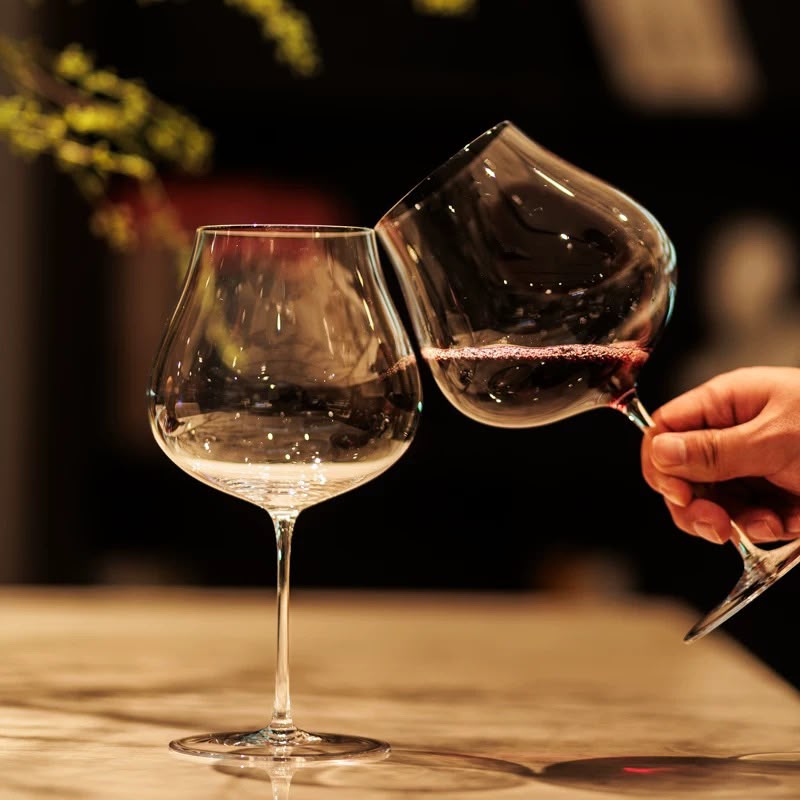
Fine hand-blown stemware often feels lighter than its scale suggests. The stem may appear to rise naturally from the bowl; the rim can feel quiet at the lips; the base can look poised rather than heavy. These are not decorative details. They shape the physical rhythm of lifting, drinking, and returning the glass to the table.
Machine-made glasses often feel more uniform from piece to piece. Depending on the design and process, they may carry more material through the rim or stem, though sophisticated production can also achieve impressive finesse. Pick up the glass. Look through the bowl. Run a fingertip carefully around the rim. A product description cannot replace this direct assessment.
Variation is information
Because people shape hand-blown objects, tiny differences can occur. A slight variation in height, foot, or wall can be evidence of the process rather than a defect. The important question is whether the set still feels balanced and intentional. Variation should never excuse instability, rough finishing, or proportions that interfere with use.
Machine production is the stronger choice when exact dimensional uniformity is essential—for example, a very large operation that needs rapid replacement and perfect alignment across hundreds of covers. Hand-blown service creates a different kind of order: a coherent family with a trace of the maker still present.
Durability is a use question
Thicker is not always synonymous with better, and lighter is not synonymous with fragile in every circumstance. Breakage depends on material, design, thermal shock, impact, washing, storage, and handling. A fine glass should be used with awareness, but it should not require ceremony every time you pour wine.
Before buying, ask whether the glass is intended for normal service, whether careful dishwasher use is supported, and whether replacement pieces are available. Read the care guidance rather than relying on broad assumptions about handmade objects. A beautiful glass earns its value by being used.
How to evaluate value
Consider the full experience: the clarity of the bowl, the finish of the rim, the balance between bowl and base, the steadiness of the foot, and how naturally the stem sits between your fingers. Then consider the life around it—packaging, care information, replacement options, and whether the design forms a coherent collection.
Persephaure’s hand-blown collection is designed around the complete table, with ten different bowls sharing one visual language. Explore the hand-blown collection if you value purpose-shaped forms and an object that retains the presence of craft. Choose machine-made when uniformity, cost, and replacement speed matter more. Neither answer needs an apology.
- Look for a smooth, quiet rim and a stable, level base.
- Judge weight as balance, not simply as a number.
- Ask how the set will be washed, stored, and replaced.
- Choose a production method that fits the life of the table.